Sunset Beach sits right on the Pacific with a mild coastal Mediterranean climate that keeps summers cool but allows persistent humidity to linger in attics. Many homes here date from the mid-20th century with older roof decks and limited ventilation, so even small roof leaks or bathroom exhaust fans venting into the attic can create hidden moisture pockets. Salt air accelerates corrosion on metal flashing and fasteners, letting water seep in during winter storms that still reach Orange County despite the overall mild weather. Testing must account for these conditions because standard moisture meters can give false readings on salt-contaminated wood.
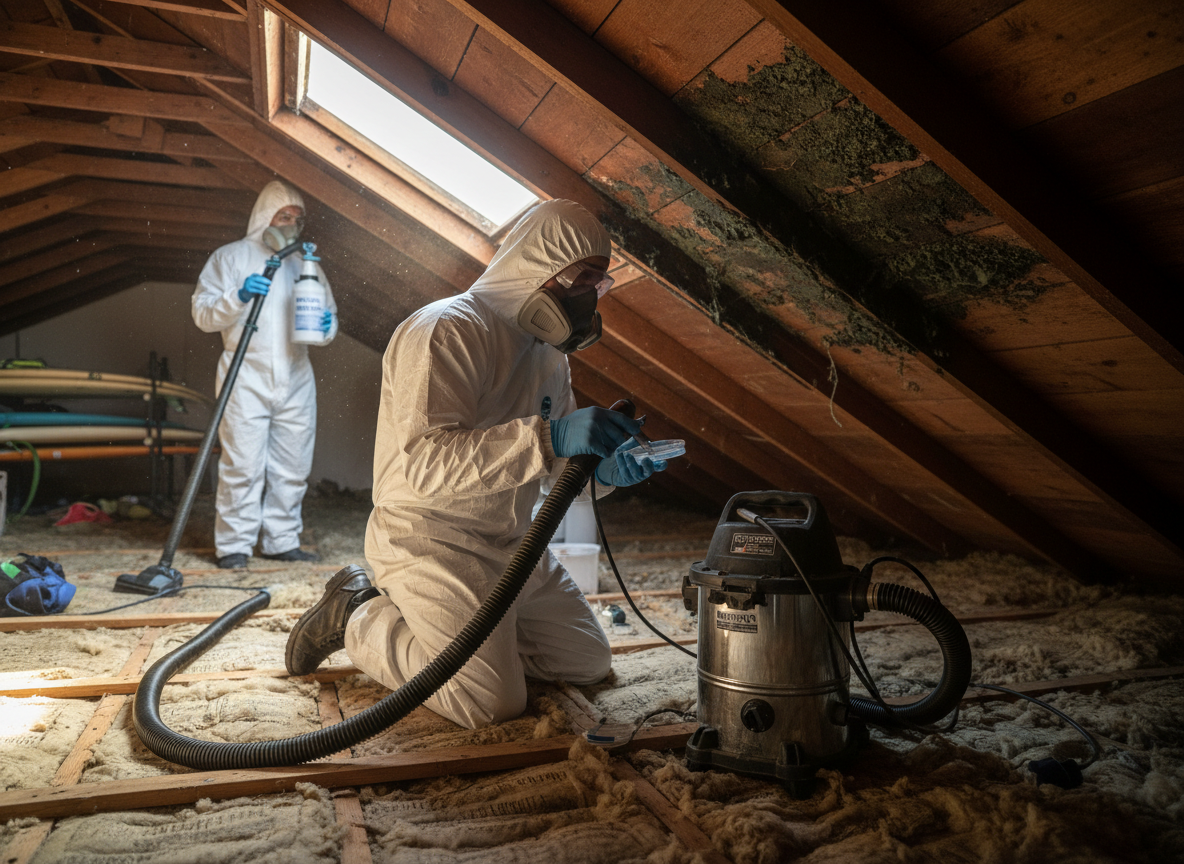
Removal work in these attics often requires isolating the space from living areas below because many Sunset Beach houses have open-beam or low-slope rooflines with limited access. We use negative air machines and HEPA filtration to keep spores from drifting into adjacent rooms while removing affected insulation and sheathing. Containment is especially important near the Pacific Coast Highway corridor where homes sit close together. After physical removal we treat remaining surfaces with EPA-registered antimicrobials formulated for coastal environments and then improve airflow with new ridge and soffit vents sized for the actual roof pitch.
Homeowners in nearby Seal Beach and Huntington Beach face the same issues because the housing stock and proximity to the ocean are nearly identical. We always check the entire attic plane rather than spot-treating because mold frequently travels along rafters where condensation forms at the cool ocean air meets warmer interior temperatures. Documentation of pre- and post-remediation moisture levels and spore counts is provided so you can see exactly what changed.
Seasonal Guidance
Even with cool summers, winter rain combined with ocean fog can keep attic humidity above 60 percent for weeks. Scheduling testing after the first substantial rain of the season catches problems before they spread into living spaces.
Technician insight
In Sunset Beach the thing that catches most people out with Attic mold testing and removal is how salt air corrodes roof fasteners and lets tiny leaks go unnoticed for years. The mild climate means homeowners rarely open the attic, so condensation from bathroom fans venting into the space builds mold along the north-facing rafters that stay cooler from ocean air. Spot treatments fail here because the moisture travels the full length of the roof deck.
Hidden Growth Along North Rafters
A homeowner in Sunset Beach noticed musty odors after winter rains but no visible water stains. Inspection found elevated moisture along the north roof deck where ocean fog kept temperatures low. We removed saturated insulation, treated the sheathing, and added ridge venting sized for the low-slope roof. Follow-up testing showed spore counts returned to outdoor baseline levels.
How it works
- 1
Initial Inspection
We arrive at your Sunset Beach address and perform a full attic walkthrough using moisture meters, thermal imaging, and air sampling to map active growth and hidden moisture.
- 2
Containment Setup
Plastic barriers and negative air machines isolate the attic from the rest of the home to prevent spore migration into living areas below.
- 3
Removal and Treatment
Affected insulation and wood are removed, surfaces are cleaned and treated, and we address the moisture source such as roof leaks or improper venting.
- 4
Verification and Restoration
Post-remediation testing confirms spore levels are back to normal, then we reinstall insulation and improve ventilation before final walkthrough.
Pricing
Upfront quotes after on-site inspection because attic size, access difficulty, and extent of hidden growth vary widely in Sunset Beach homes.