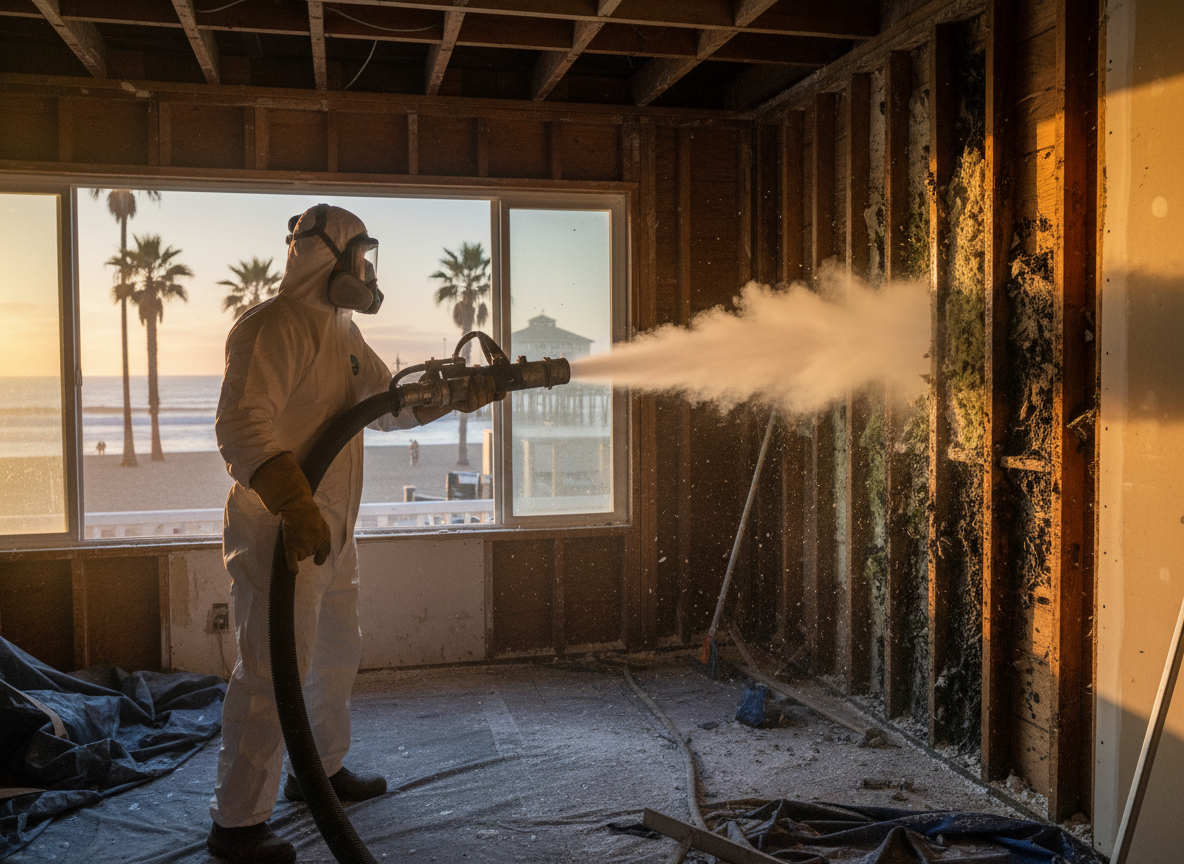
Dry ice blasting propels solid CO2 pellets at high velocity to dislodge mold colonies from wood framing, drywall, and concrete in Sunset Beach homes. The process sublimates on contact, leaving no secondary waste that could feed new growth in the area's persistent marine layer humidity. Older cottages near Pacific Coast Highway often have tight crawl spaces where traditional sanding creates dust that settles into salt-laden air and restarts colonies within weeks.
Technicians must account for the county's cool summer fog that keeps relative humidity above 70 percent even when temperatures stay moderate. This slows drying after blasting, so containment barriers and negative air machines run longer than in inland Orange County neighborhoods. Edge cases include stucco exteriors on Seal Beach border homes where moisture migrates through hairline cracks and hides behind lath, requiring targeted blasting rather than full-wall removal.
Code considerations in Huntington Beach-adjacent properties include verifying that blast media does not affect fire-rated assemblies or disturb lead paint common in pre-1978 construction. Post-blast HEPA vacuuming and moisture mapping prevent re-growth when homeowners reopen windows to the ocean breeze. The method works best on non-porous substrates; porous materials still need removal if saturation exceeds 20 percent.
Access challenges arise in elevated beach houses where scaffolding must protect neighboring decks from pellet scatter. Crews coordinate with local tide schedules to avoid equipment staging on sand during high surf warnings that affect Sunset Beach access routes.
Technician insight
In Sunset Beach, the thing that catches most people out with dry ice blasting mold is salt corrosion on metal lath behind stucco in homes built before the 1980s. The ocean air keeps surfaces damp longer after blasting, so we extend drying time or the mold returns within a month.
Crawl Space Mold After Winter Fog
A 1960s Sunset Beach cottage showed black growth on joists after months of marine layer moisture. We found hidden saturation along the foundation near Pacific Coast Highway. Dry ice blasting cleared the colonies from wood without adding water, followed by targeted drying. The homeowner reported no recurrence after six weeks of normal coastal humidity.
How it works
- 1
Site Assessment
Inspect affected areas in Sunset Beach homes for moisture sources tied to coastal fog and salt air intrusion.
- 2
Containment Setup
Install negative air and plastic barriers to isolate work zones from living spaces in older wood-frame cottages.
- 3
Dry Ice Blasting
Apply CO2 pellets to surfaces, adjusting pressure for wood versus concrete without damaging historic trim.
- 4
Cleanup and Drying
HEPA vacuum residues, then run dehumidifiers until readings drop below local humidity norms.
- 5
Final Verification
Moisture meter and visual check confirm clearance before barriers come down.
Pricing
Pricing varies by square footage, access difficulty, and whether additional material removal is required after blasting.