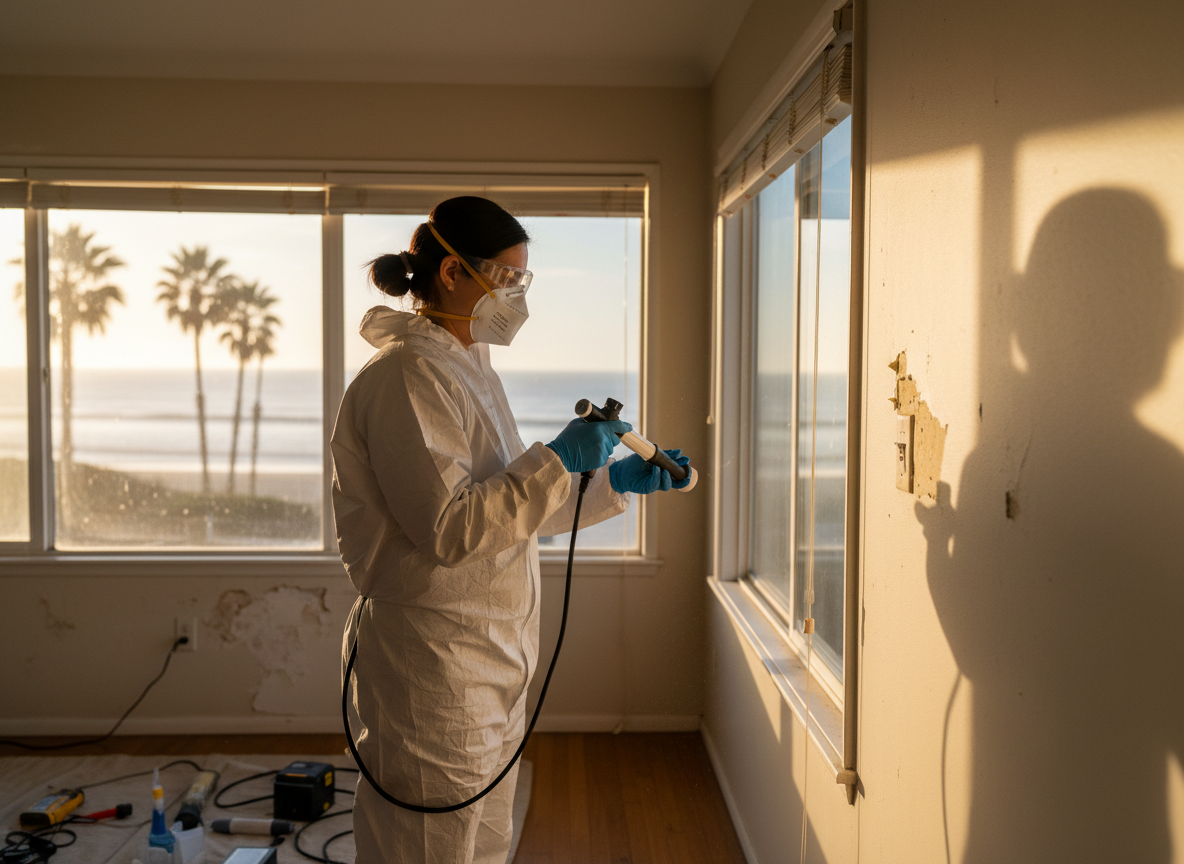
Sunset Beach sits along the Pacific Coast Highway in Orange County where the mild Mediterranean climate keeps summers cool but allows ocean-driven humidity to linger inside older beach cottages and 1960s-era homes. These structures often have crawl spaces and single-pane windows that trap moisture from marine layers, creating conditions where mold spores settle on drywall, insulation, and subfloors without obvious water stains. Air sampling combined with surface tape lifts reveals both visible colonies and hidden growth behind walls that residents in nearby Seal Beach and Huntington Beach encounter at similar rates.
Testing begins with a walk-through to identify high-risk zones such as bathrooms, laundry rooms, and areas near the beach where salt air accelerates corrosion of metal vents and window frames. Technicians collect multiple air samples at different heights and outside control samples to compare spore counts against regional baselines for Orange County. Surface samples from baseboards and HVAC registers catch species like Stachybotrys and Aspergillus that thrive in the cool, damp summers typical here, giving homeowners data before remediation decisions.
Results include a written report with spore types, concentrations, and photographs of sample locations. This documentation helps differentiate between normal outdoor levels brought in by sea breezes and elevated indoor readings that require targeted removal. Homes near the water often show higher baseline readings due to constant salt-laden air infiltration, so the report always notes location-specific factors rather than generic thresholds.
Follow-up testing after any cleanup confirms spore levels have returned to outdoor norms, an important step in coastal neighborhoods where re-growth can occur quickly if humidity control is overlooked.
Technician insight
In Sunset Beach, the thing that catches most people out with mold spore testing is how the mild coastal Mediterranean climate keeps indoor humidity elevated year-round in the older single-wall construction homes along Pacific Coast Hwy, so a single sample often under-reports growth that shows up only after multiple locations are tested.
Hidden Growth Behind Kitchen Cabinets
A homeowner in a 1960s cottage near the beach reported musty odors after cool summer fogs. Testing found elevated Aspergillus spores in the kitchen despite no visible water damage. Samples from behind the cabinets and under the sink confirmed hidden growth tied to repeated condensation from the marine layer. Targeted removal and dehumidification brought levels back in line with outdoor controls.
How it works
- 1
Site Assessment
Technician reviews the property layout, notes age of construction, and maps moisture-prone areas common in Sunset Beach homes.
- 2
Sample Collection
Air and surface samples are taken from multiple indoor zones plus an outdoor control, using calibrated pumps and sterile media.
- 3
Laboratory Analysis
Samples are sent to an independent lab for spore identification and count, with results typically available within two business days.
- 4
Report Delivery
Detailed findings with photos and location notes are provided along with recommendations for next steps if counts exceed outdoor baselines.
Pricing
Cost depends on number of samples and square footage; call 24/7 for an upfront quote based on your specific Sunset Beach address.