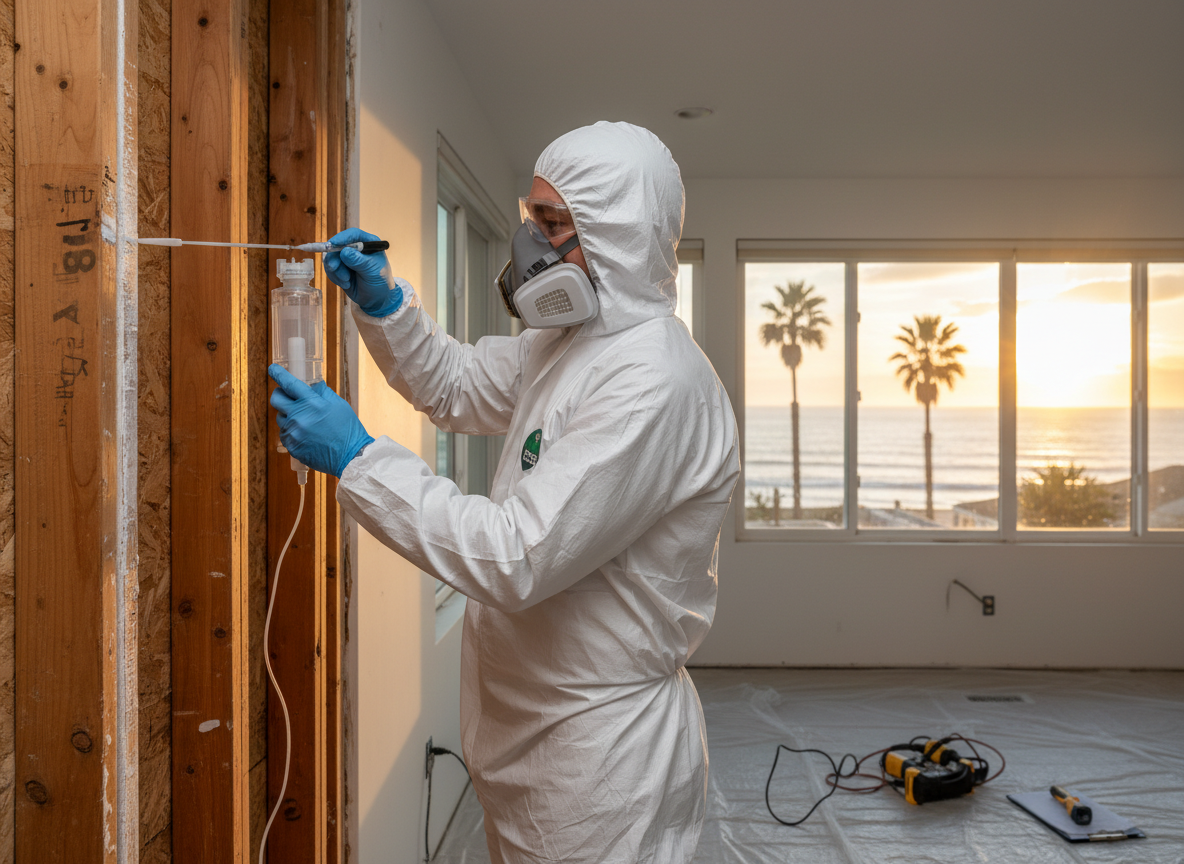
Post remediation mold testing in Sunset Beach homes requires sampling after containment removal and drying to confirm spore counts match outdoor baselines. Coastal Mediterranean conditions keep summer humidity moderate yet persistent fog and salt air can leave moisture in older wood-frame structures near Pacific Coast Highway. Technicians collect air samples from multiple rooms plus outdoor controls, plus tape lifts or swabs on remaining surfaces like drywall seams or subflooring that often trap residual spores in 1960s and 1970s beach cottages.
Edge cases arise when testing follows water intrusion from winter storms or plumbing leaks common in Seal Beach and Huntington Beach adjacent properties. Negative-pressure setups must be fully dismantled before sampling to avoid false negatives, and HVAC systems require separate verification because ductwork in slab-on-grade homes can harbor hidden growth. Results are compared against EPA and IICRC guidelines without relying on visual inspection alone, since microscopic spores remain invisible after cleaning.
Homeowners sometimes request testing too soon after remediation, before materials reach equilibrium moisture levels below 12 percent. In Sunset Beach the steady onshore breeze can mask lingering dampness in enclosed spaces like crawlspaces or behind kitchen cabinets. A second round of sampling 48 hours later is often needed when initial readings show borderline elevations tied to the area’s mild but constant marine layer.
Technician insight
In Sunset Beach the thing that catches most people out with post remediation mold testing is the marine layer that keeps crawlspaces and wall cavities above 60 percent relative humidity even after drying equipment is removed. Older homes along Pacific Coast Highway often have layered additions that trap pockets of moisture behind new drywall, so we always pull baseboards and check the original framing before final sampling.
Hidden Moisture Behind Kitchen Remodel
After flood remediation in a 1972 Sunset Beach cottage, the homeowner requested clearance testing. We found elevated aspergillus in air samples from the kitchen. Further inspection revealed damp plywood under new tile from an undetected slab crack. Additional drying and a second round of samples produced counts matching the outdoor baseline.
How it works
- 1
Containment Removal And Site Preparation
Technicians confirm all plastic barriers and negative air machines are down and surfaces are dry before any sampling begins.
- 2
Outdoor Baseline Collection
Air samples are taken outside the property near Sunset Beach to establish the natural spore level for comparison.
- 3
Indoor Air And Surface Sampling
Multiple indoor air cassettes plus surface lifts are collected from affected rooms, HVAC returns, and previously hidden cavities.
- 4
Laboratory Analysis And Report
Samples are sent to an accredited lab for spore identification and count comparison, followed by a written clearance report.
Pricing
Cost depends on square footage, number of samples required, and whether HVAC testing is included.