Sunset Beach sits right on the Pacific in Orange County with cool summers that keep relative humidity elevated much of the year. Older beach cottages and 1950s-1970s tract homes along Pacific Coast Highway often have crawl spaces and stucco exteriors that trap moisture after winter storms or fog. Professional mold removal here starts with moisture mapping using thermal imaging to locate hidden growth behind walls or under flooring before any demolition begins.
Because Seal Beach and Huntington Beach share the same low-lying coastal terrain, salt air accelerates corrosion on metal HVAC components and window frames, creating chronic leak points that feed mold colonies. Technicians remove affected drywall and insulation in full containment zones, then apply EPA-registered antimicrobials followed by HEPA air scrubbing. Final clearance testing confirms spore counts match outdoor baselines before reconstruction.
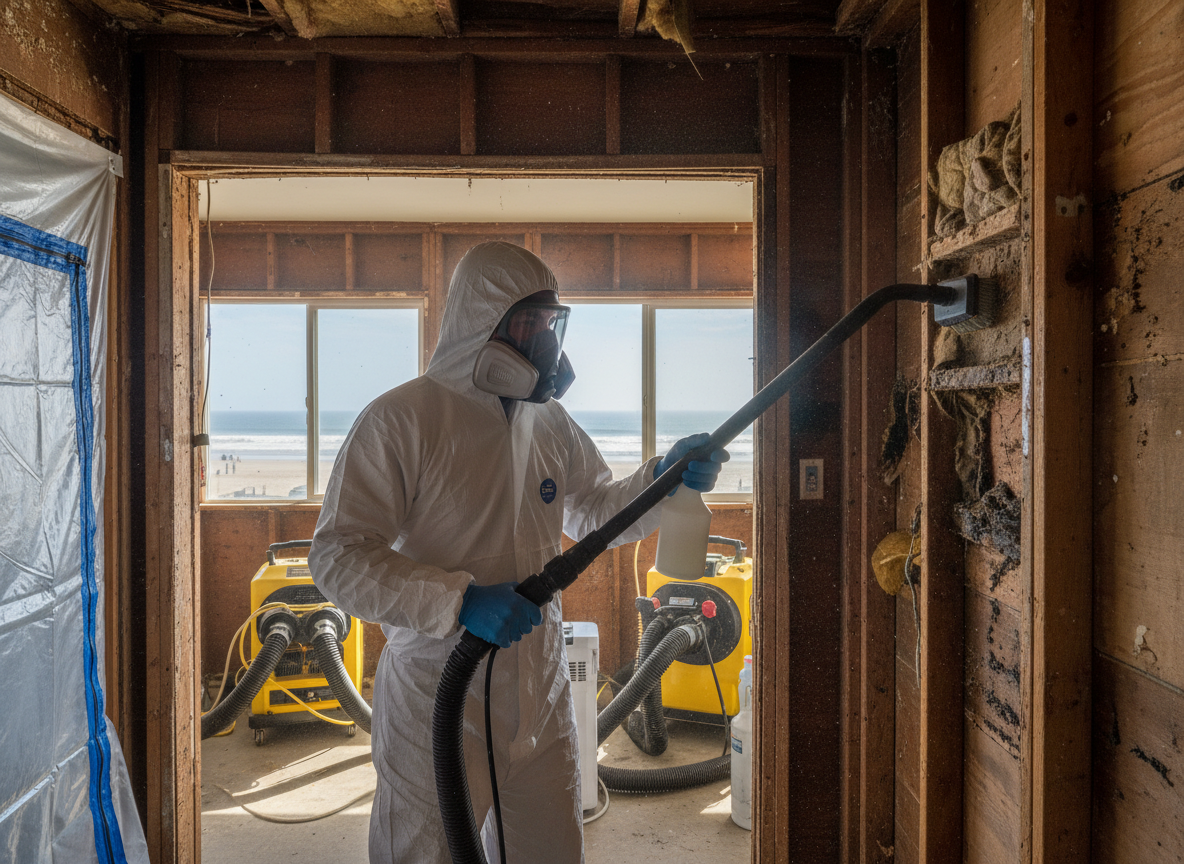
Homeowners sometimes attempt bleach cleaning on visible spots only to miss root growth inside insulation or subflooring. In this climate, even small plumbing leaks in slab-on-grade homes can spread under tile within weeks. Proper removal requires negative air machines and full PPE to prevent cross-contamination to unaffected rooms during the process.
After remediation, dehumidifiers sized for the square footage run until indoor humidity stays below 50 percent. This step is critical in Sunset Beach where ocean breezes alone rarely dry out enclosed spaces fast enough during summer marine layers.
Technician insight
In Sunset Beach the thing that catches most people out with professional mold removal is how quickly marine layer humidity re-wets crawl spaces after we finish. Homes built before 1970 along Pacific Coast Highway often have dirt floors and no vapor barriers, so even after we pull the visible growth the soil stays damp enough to restart colonies within weeks unless we address the ground moisture directly.
Crawl Space Growth After Winter Rain
A 1962 beach cottage near the intersection of Pacific Coast Highway and Anderson Street developed musty odors after heavy December rains. We found black mold on joists and insulation above saturated soil with no vapor barrier. Containment was built from the exterior access door, affected materials were removed, and a sealed vapor barrier plus dehumidifier were installed. Air samples cleared within 48 hours and the odor did not return.
How it works
- 1
Initial Inspection
Technician arrives within hours, maps moisture with meters and infrared cameras, and identifies all affected materials in Sunset Beach homes.
- 2
Containment Setup
Plastic barriers and negative air machines isolate the work zone to keep spores from spreading to living areas.
- 3
Removal and Cleaning
Damaged drywall, insulation, and trim are removed; surfaces are treated with EPA-registered solutions and HEPA vacuumed.
- 4
Drying and Verification
Dehumidifiers and air movers run until moisture levels normalize, followed by independent air sampling for clearance.
- 5
Final Report
Written documentation of findings, actions taken, and post-remediation conditions is provided before any reconstruction begins.
Pricing
Cost depends on square footage affected, depth of hidden growth, and access difficulty in older coastal construction.